
The only guide that does both
In 2026, Google Ads has become a black box. Performance Max, Smart Bidding, AI Max: the algorithm does whatever it wants with your budget, and you watch your dollars disappear without knowing why. Paying an agency $800 to $2,000 a month? Spending $500 or $1,000 on a course? You have neither the time nor the certainty of seeing a return.
This guide does the two things no one else does in the same resource: it first teaches you to run Google Ads yourself (account structure, bidding, Quality Score, Search, Performance Max, Demand Gen, account audit) until you truly understand what's happening in your account. Then it shows you how to connect Claude, the AI, so it monitors, optimizes, writes your ads, and builds your landing pages on your behalf.
You become the self-reliant pro of 2026: someone who has mastered the craft hands-on and who then puts AI to work for them, without being glued to a platform that changes every few months.
All of this in 52 dense pages, current as of June 2026, downloadable in thirty seconds.
Even if you've never launched a single campaign. Even if you've already burned through budget with nothing to show for it. Even if Google's AI has already made you feel like you've lost control.
Google Ads in 2026: what has actually changed?
Google Ads is Google's advertising platform (Search network, Shopping, YouTube, Display). In 2026, it runs on artificial intelligence: Performance Max, Smart Bidding, and AI Max make bidding and targeting decisions for you. The advertiser's role has shifted toward signal quality (conversion data, account structure, creative) and, now, toward using an AI like Claude to automate campaign management.
Do any of these sound familiar?
Before telling you about this guide, I need to ask you 4 quick questions.
If you answered yes to at least two of those questions, you're not alone.
The vast majority of freelancers, small business owners, and e-commerce operators who manage their own Google Ads account live with exactly this situation. They watch their campaigns run. They see the budget go. They don't know precisely why it isn't working, and Google isn't going to explain it to them. The platform is designed for you to spend more, not to spend smarter.
What's painful about this situation isn't just the wasted money. It's the feeling of no longer being in control. Google has removed the levers one by one: first control over bids with Smart Bidding, then transparency over targeting with Performance Max mixing all your channels into a black box, and now AI Max promising to automate even further. If you don't understand the underlying mechanics (how the auction works, what the algorithm actually wants, how to give it the right signals), you're condemned to just react.
And if you handed your account to an agency to escape that, you know how uncomfortable it is to pay every month without being able to judge the work being done. You trust them, or you pretend to. Because you don't have the keys to evaluate what's good or bad yourself.
That dependency is expensive: in money, in time, and in peace of mind.
But here's what I learned after managing real Google Ads accounts for actual clients: mastery is acquirable. Google's algorithm is not an impenetrable black box. It's a system with clear logic, one you can learn in a few dozen hours if it's taught in the right order. And once you understand that logic, something remarkable becomes possible: you can connect an AI that works for you, monitors your campaigns, optimizes your bids, and writes your ads while you run your business.
That's exactly what this guide gives you.
Before getting here, I tried everything. And failed at all of it.
Free YouTube tutorials
Hours and hours of videos, people screen-sharing while talking fast, advice from 2019 or 2021 that no longer matches the current interface. Every new video brought a new opinion. Every Google update made everything stale. I felt like I was learning. But the day I launched my first campaign, I was just as lost as before. Budget going out, clicks coming in, conversions: zero.
Trusting Google's automation
"Let our AI work for you." I followed the automated recommendations. The result? In three weeks, I had doubled my spend. And my conversions? Still zero. Google was optimizing for its own revenue, not mine. Performance Max had sucked up my entire budget on queries I would never have consciously bought. I had lost control, along with my money.
Paying an agency
A $1,200/month contract, a $500 setup fee. A 12-page monthly report full of line graphs. But when I asked precise questions (why this keyword, why this bid, why my Quality Score was stuck at 4/10), I got vague answers, jargon, and a pitch for a higher-tier package. After four months and $5,300 spent, I stopped. Without having learned a single thing.
The "serious" courses at $997, $1,500, $2,000
Video modules recorded two years ago, a half-dead Discord community, a PDF certificate at the end. Before you could even check whether the content was current, you had to hand over your credit card and hope. For a freelancer who accounts for every dollar of budget, betting a thousand on a promise you can't evaluate before purchase is a risk many simply can't take.
Winging it solo, going by gut
Change a bid here, test an ad copy there, tweak targeting by feel. Without a method, without understanding how the auction works or what Quality Score implies, every change created a new problem I couldn't diagnose. I kept going in circles. Spending hours in the interface for results that never improved.
What all these paths share: time wasted, money burned, and frustration that compounds. Free tutorials never go deep enough. Google's blind automation serves Google, not you. The expensive agency leaves you dependent and in the dark. High-ticket courses impose an entry price the results don't always justify. And winging it by instinct is like hoping a plane takes off without reading the flight manual.
None of these solutions fix the real problem: you don't understand what's happening in your account, so you control nothing.
That's exactly why this guide exists.
Picture your day-to-day three months from now
You open your Google Ads interface. You know exactly what you're looking at. Quality Score, bid, match type, conversion signal: every number means something, every lever has a logic. You're no longer at the mercy of Google's algorithm. You understand how it thinks, you know how to steer it. That confusion that used to paralyze you, that lost feeling in front of Performance Max and AI Max, it's gone. You've mastered the craft hands-on. And that kind of mastery can't be bought: it has to be understood.
But here's what changes everything.
You're no longer glued to that interface for hours every week. Because you've connected Claude to your Google Ads account. Claude monitors your campaigns while you focus on other things. It detects parasitic keywords, adjusts bids, and flags opportunities. You come home in the evening, glance at the report Claude generated, approve the key decisions, and that's it. The repetitive, time-consuming work that used to weigh on you runs in the background, driven by an AI you configured yourself, because you already understood the craft.
Your ads are written by Claude, based on your instructions. Your landing pages are produced in minutes. Your conversion signals are clean, your campaigns are structured, your budget no longer goes up in smoke on queries that never convert.
You look at your dashboard. Cost per lead is dropping. ROAS is climbing. You know exactly why: you built this system yourself, brick by brick.
Your competitors are still paying $1,500 a month to an agency that sends them incomprehensible PDF reports. You're running an AI. You've become the self-reliant pro of 2026: you've mastered Google Ads, and you put artificial intelligence to work for you.
What you've built is worth several thousand dollars in training. It cost you $29, a few hours of reading, and the decision to stop reacting and start understanding.
What will you learn in this guide?
How to make Google Ads (and AI) work for your business, even if you're starting from zero.
Finally understand the Google Ads auction from A to Z and never again feel lost when automated recommendations push you to spend more. You'll take back control.
Structure a Google Ads account the right way, avoid the beginner mistakes that burn budget, and lay solid foundations from the very first campaign.
Why most small advertisers waste their budget without knowing it, and the 3 immediate fixes that make every dollar actually work (page 18).
A full visual walkthrough to launch your first Search campaign: from keyword selection to bids to writing RSA ads.
What you should never do with Performance Max, and how to configure it to work in your interest rather than Google's.
Match types explained clearly: when to use EXACT, PHRASE, or Broad Match, and why that choice can cut your cost per conversion by 3x.
Connect Claude (AI) to your Google Ads account via Claude Code and MCP to monitor, optimize, and create ads automatically. The first guide to show you exactly how to do this.
Reclaim several hours a week through AI autopilot. No more manual optimization sessions on Saturday morning: Claude analyzes your account and surfaces what matters.
3 ready-to-use sector playbooks (local leadgen, e-commerce, B2B/SaaS) so you never start from a blank page (modules 16, 17, 18).
The mistake everyone makes when activating Smart Bidding too early, and how to respect the learning phase so the algorithm works in your favor.
How to measure campaign incrementality: the only metric that tells you whether your ads are actually generating additional revenue.
The 8-block account audit method to diagnose any campaign in under an hour: your own, or a client's you want to charge for.
The Claude automation bonus workshop: build a landing-page factory, industrialize campaign creation, and optimize your conversion signals, the level most pros haven't reached yet.
All of this updated to June 2026: AI Max, Performance Max with channel-level reporting, Display-to-Demand Gen migration, unified enhanced conversions, Google Marketing Live 2026 announcements.
Google Ads Mastery 2026, Cyberyweb Edition
A dense 52-page PDF, designed to be read once and referenced for life.
52 pages of practitioner content
No filler, no recycled blog theory. Every page maps to a method tested on real, actively managed Google Ads accounts.
18 structured modules + bonus
Five parts that build in power, from core vocabulary all the way to AI-driven campaign management.
Real screenshots
Taken in June 2026. You see exactly where to click, what to look for, without guesswork.
Checklists and playbooks
Printable checklists, sector playbooks, benchmarks, a complete glossary, and a clickable table of contents so you find any section in two seconds.
Updated for the AI Max era
Performance Max with channel-level reporting, Display-to-Demand Gen migration, unified enhanced conversions, Google Marketing Live 2026 (AI Mode, Universal Cart, Asset Studio). Nothing stale.
Instant download
You receive the PDF within seconds on any device: laptop, tablet, phone. Read it wherever you want, whenever you want.
Lifetime access, one-time payment
Pay once, keep it forever. No platform that shuts down, no subscription to renew. A PDF file, yours for life. $29 instead of $149, secured by Stripe.
Two years ago, we were managing accounts just like you
We configured keywords by hand, adjusted bids line by line, spent hours dissecting search term reports. It was slow. It was tedious. But we had mastery. Or at least that illusion of mastery.
Then Google changed everything. Performance Max. Smart Bidding. AI Max. Automatically. All at once.
The levers we'd held for months disappeared from our hands. The interface transformed. Reports grew thinner. And Google's automated recommendations ("increase your budget," "switch to broad match targeting," "let us optimize for you") started crowding every screen.
On a client account, we watched this shift happen in real time: a well-structured Search campaign, converting at a controlled cost, suddenly replaced by a Performance Max the algorithm managed on its own. Budget going out. Impressions inflating. Conversions, flat. And understanding why had become nearly impossible: granular data had vanished behind the veil of automation.
We found ourselves facing an uncomfortable question: were we still in control, or were we paying Google to optimize its own revenue?
That question, we didn't ignore. We dug into it. We spent weeks dissecting the new mechanics: how Quality Score recalculates in an AI Max world, how Smart Bidding reads conversion signals, how Performance Max decides where to spend when given a blank check. We audited accounts. We tested structures. We measured the impact of every parameter we could still control.
And then something flipped.
We understood that Google's automation wasn't the enemy. It was a powerful tool, but a blind one when it isn't guided correctly. The real skill no longer lived in manually adjusting every bid. It lived in building the foundations the algorithm can't build on its own: a clean account structure, airtight conversion tracking, strong first-party signals, landing pages that actually convert.
Master that first. Then let the algorithm work on healthy foundations.
But the story doesn't stop there. Because at the same time, we were using Claude (Anthropic's AI) on our own automation projects. And an intuition emerged: what if we connected Claude directly to our Google Ads accounts?
We built the stack. Claude Code. The MCP Google Ads connector. A few weeks of iteration. Today, Claude monitors our campaigns, detects anomalies, suggests optimizations, generates ad variants and landing pages. Tasks that used to take us two hours every week now take minutes, and often get done better: AI doesn't get tired, doesn't miss a midnight alert, and crosses data points no human would intuitively compare.
This isn't magic. It's method. First, understand the craft. Really understand it, not just click buttons. Then, delegate the management to an AI that works on solid foundations.
That's exactly the dual learning we put into this guide. Not recycled theory. The method we apply on our own accounts, condensed into 52 pages, for $29.
Because in 2026, it's not the fastest clicker who wins. It's the one who understands what Google's AI is doing, and knows how to answer it with an even sharper AI.
I'm not asking you to take my word for it
Here's what Google's public data and authoritative practitioners say instead. These cases are broken down module by module in the guide, so you understand which decision produced which result.
Practitioners whose methods are integrated in this guide
Co-founder of Optmyzr, former Google Ads engineer. His work on responsible automation and smart bidding control structures the expert management section.
Recognized expert in bidding strategy and Smart Bidding, regularly featured at Search Marketing conferences. Her recommendations on conversion signals flow through the Search and Performance Max modules.
Founder of SavvyRevenue, account audit specialist. His systematic block-based audit method inspires Part IV, where you learn to diagnose an account like an expert.
Cyberyweb: an agency that applies these methods on real accounts. This guide wasn't written by a theorist. Cyberyweb actively manages Google Ads accounts for real clients: small businesses, retailers, service providers. The strategies taught here are the ones we deploy in production, not abstract concepts from slide decks.
The underlying trend: the most advanced advertisers are moving to agentic AI. In 2025 and 2026, a quiet shift has happened. The advertisers getting the best results no longer spend their days inside the Google Ads interface. They've connected AIs (Claude, ChatGPT, Gemini) to their accounts to monitor, alert, optimize, and write ads continuously. This is no longer experimentation: it's becoming the new standard. This guide puts you in that camp right now, for $29.
Concrete content, not recycled theory
Dense pages, tables, actionable callout boxes, and real screenshots of the Google Ads interface as of June 2026.
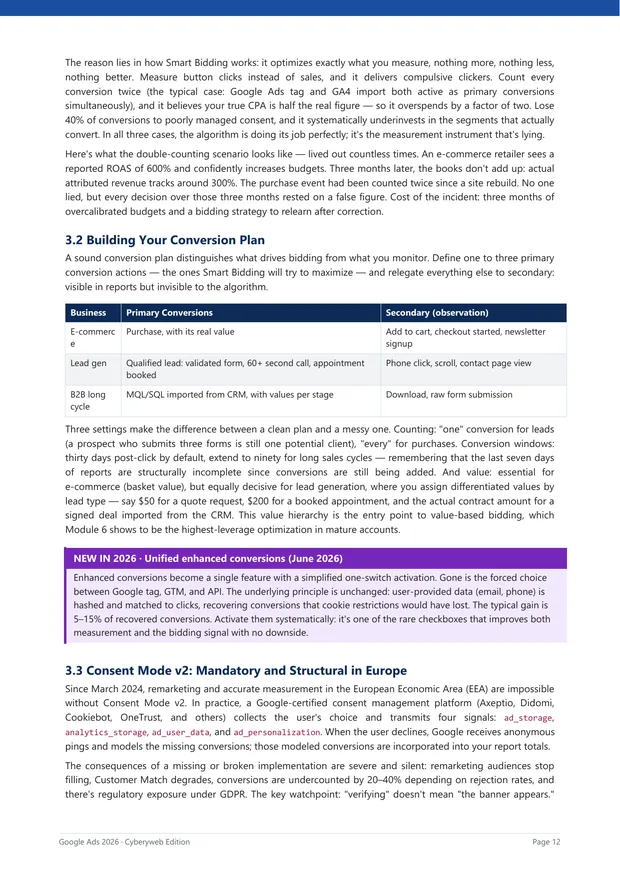
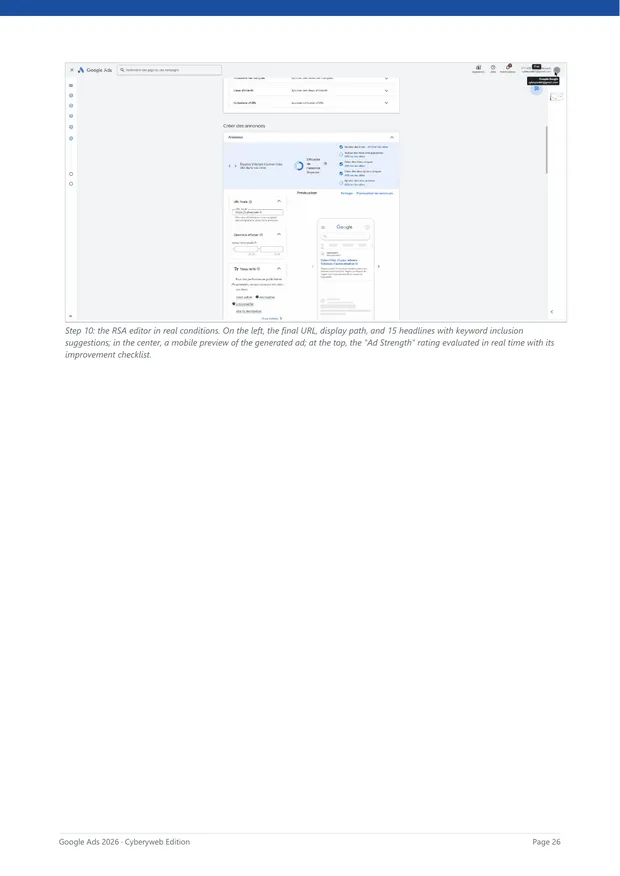
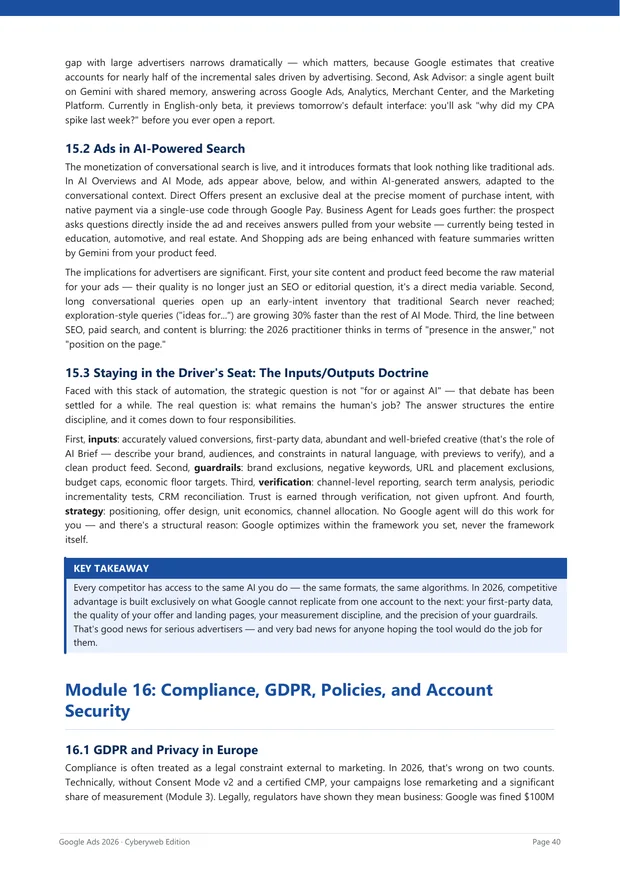
We've rebuilt accounts from ruin, from scratch. Recently, we took over one of our own Google Ads accounts, audited at a 30/100 Health Score: budget burned on parasitic keywords ("free," "css," "jobs"...), zero conversions in 30 days. We stopped everything and rebuilt: structure, tracking, bids, landing pages. The method behind that audit is fully documented in the guide, with real screenshots. We're not giving you theory: we're giving you the playbook we use ourselves.
The content is dated and verifiable. This guide was written in June 2026, after Google Marketing Live 2026. The screenshots show the interface as it exists today, not recycled 2022 captures. AI Max, Performance Max with channel-level reporting, Display to Demand Gen migration, unified enhanced conversions, AI Mode, Universal Cart, Asset Studio: it's all in there.
What is this guide actually worth?
| Option | Cost | Limitation |
|---|---|---|
| Google Ads consultant audit | $500 to $800 | One-time, you stay dependent |
| Agency managing your campaigns | $800 to $2,000/month | You learn nothing |
| Market courses | $297 to $997 | Often dated 2022, no AI Max or Claude |
| Wasted budget (1 month without a method) | $100 to $500 | Recurring and invisible |
| This guide | $29 one time | Updated 2026 + AI-driven management |
Avoiding a single month of wasted spend is worth ten times the price of this guide. It condenses in 52 pages the complete method, from foundations to AI automation, the same method Cyberyweb applies on real accounts, not a compilation of articles.
For the price of two coffees a week for a month, you stop flying blind and become the self-reliant pilot of your campaigns, with an AI working for you.
"What if the content doesn't suit me?"
A fair question. Here's why the real risk is nearly zero, and why the only real risk is doing nothing.
$29, the price of a lunch
Serious courses cost $497 to $2,000. Agencies charge $800 to $2,000/month. Here, the complete method for $29, one-time. If the guide saves you even one week of poorly spent budget, it's paid back a hundredfold.
You see what you're buying
No black box. Before checking out, you have the full table of contents for all 18 modules, real screenshots (June 2026), and the complete 52-page structure. If the content doesn't suit you after reading the table of contents, don't buy. It's that simple.
Updated to June 2026
AI Max, Performance Max with channel-level reporting, Demand Gen, unified enhanced conversions, Google Marketing Live 2026 announcements. Not content recycled from three years ago: what Cyberyweb applies today on actively managed accounts.
Lifetime access, no expiry
Download the PDF once and it's yours forever. No platform that disappears, no subscription to renew. The file is yours.
100% secure payment via Stripe
Your card details never pass through our servers. Stripe is the global standard for online payments, the same one used by Amazon and Shopify. Payment takes ten seconds, the PDF is yours immediately.
Cyberyweb's quality commitment
This guide condenses the method we apply every day on real accounts. If Google rolls out a major update that makes part of the content obsolete, we update the guide and you receive the new version at no extra cost.
The real risk isn't buying. It's continuing without understanding.
Every week without mastering Google Ads is budget going up in smoke on parasitic keywords, miscalibrated bids, poor Quality Scores. That's money handed to Google, and to competitors who know exactly what they're doing. The only question left: how much more budget will you waste before taking back control?
This guide isn't for everyone
Let's be direct: some profiles will get enormous value from this. Others will waste $29.
This is NOT for you if...
- You're looking for a magic wand. The modules are dense, the playbooks are actionable: if you expect a profitable campaign without understanding or applying anything, no guide will help you.
- You want to stay 100% dependent on an agency and never touch your account. The objective here is autonomy.
- You flat-out refuse to use AI tools. A large part of the value (Part V + bonus) is devoted to Claude-driven management.
- You'll read it once and archive it without putting anything into practice. The only risk is never reopening the file.
This is exactly for you if...
- You're the kind of person who applies what they learn.
- You want to understand before you delegate: to challenge an agency, or take the reins yourself.
- You see AI not as a threat, but as a productivity lever.
- You want to become the self-reliant pro of 2026: master the craft AND put AI to work for you.
The $29 price won't last
This price exists because the guide just launched and I want early readers to share their feedback. Once this launch phase is over, the price will return to $149. That's not a marketing trick, it's the reality of a launch.
But there's a deeper urgency than the price, and it doesn't depend on me: Google Ads changes every quarter. AI Max rolled out in 2026, unified Enhanced Conversions in June 2026, Performance Max absorbed Shopping, Demand Gen replaced Discovery. Every month spent managing your campaigns without understanding these mechanics is budget going up in smoke, because the interface evolves faster than any blog post or YouTube tutorial.
$29 is the cost of a lunch. It's also less than what most Google Ads accounts waste in a single day for lack of knowing what to turn off. The decision is simple: you make it now, or you put it off, and in the meantime Google keeps spending your money for you.
You're free
Free to keep fumbling through your campaigns in the dark, hoping it'll eventually work. Free to let Google optimize on your behalf and watch your budget disappear without knowing why. Free to pay an agency $1,500 a month to manage an account you don't control.
Those are legitimate choices. Plenty of people make exactly those choices.
But if you've made it this far, it's probably because you've sensed that something is off. That burning budget without understanding it can't go on. That depending on an opaque vendor isn't what you want. That Google's AI is taking more and more decisions for you, and without understanding what's happening in your account, you'll never truly take back control.
So you have a second choice. Invest $29 (one time) to finally understand the mechanics of Google Ads from A to Z. And go further: connect Claude to your account and hand it the autopilot, not to be subject to automation, but to be in command of it.
I'm not asking you to trust me on my word. The table of contents is there, the screenshots are there, the 52 pages are there. You see exactly what you're buying.
If you want to take back control of your acquisition and have your campaigns run by AI, this is where it starts.
You've made it this far. That tells me something.
It tells me you're done flying blind in Google Ads. That every dollar spent without results weighs on you a little more. That you sense AI is changing the rules of the game, and you want to be on the right side of that change, not just react to it. You're right on all three counts.
This guide exists for one reason: to give you, in 52 pages, what took me years and thousands of dollars in client budget to figure out. First, master Google Ads hands-on, truly, not just on the surface. Then, once the foundations are solid, move to the level 99% of advertisers haven't reached yet: connect Claude to your account and hand it the monitoring, optimizations, ad creation, and landing pages. Work less on the interface. Get better results.
That's exactly what you'll learn in the first pages of this guide.
Questions you might have
Is the content really up to date?
I'm a complete beginner. Is this for me?
Do I get instant access after purchase?
Do I need to install anything for the Claude workshop?
Can I ask questions after purchase?
Is the sale final?
On the other side of the checkout, Module 1 is waiting for you
The Google Ads auction mechanic, explained simply, with a diagram you'll never forget. Then, page by page, the complete journey: from hands-on mastery to automated management with Claude.
Get the guide now for $29Najib, Cyberyweb, AI automation agency
contact@cyberyweb.fr